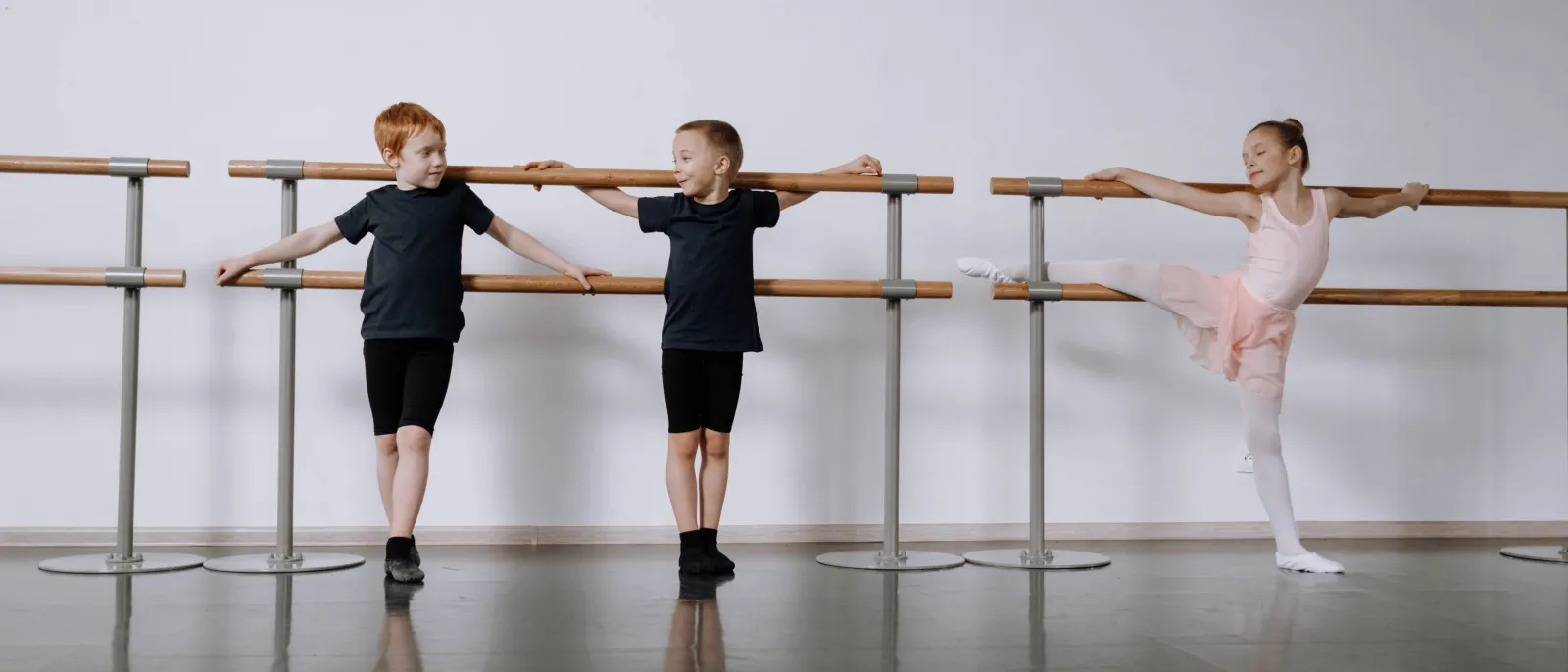
Almost every boy who dances in Ireland does it in a mixed class, alongside girls. That is not a compromise, it is just how it works here. A handful of schools also run classes only for boys, and this guide names the ones we know of. It also covers what to ask if there isn't one near you, which for most families there won't be.
Where the boys actually are
Almost every ballet class in Ireland is mixed, and almost no school says so, because there is no need to. Mixed is the default, and nobody writes down the default. When a school's website says nothing about boys, that is not a sign that boys are unwelcome. It usually means the question has never come up.
The shortage is not of welcome. It is of boys. Fewer boys are pointed towards ballet in the first place, by parents, by schools, and by the general assumption that it is something girls do. A class with one boy in it is the result of that, not the cause of it.
Irish National Youth Ballet, the country's national youth company, reports that around 20% of its dancers are male. Those dancers came up through ordinary mixed classes.
So if there's no boys' class near you, your son isn't missing out on the real thing. He'd be taking the same road as nearly every male dancer in the country.
Why some schools run boys-only classes
Where one exists, it is usually solving a specific problem. Three come up again and again.
Being the only boy in the room. Lindsay Ashe-Browne, Artistic Director of Irish National Youth Ballet, says their Boys Associates programme was set up "to give the boys a nice environment where they feel they are not the only boy in the class". She describes the effect of a male environment "from the teacher through to the dancers" as giving boys "the confidence to just continue with their classes and not feel embarrassed to enjoy dancing".
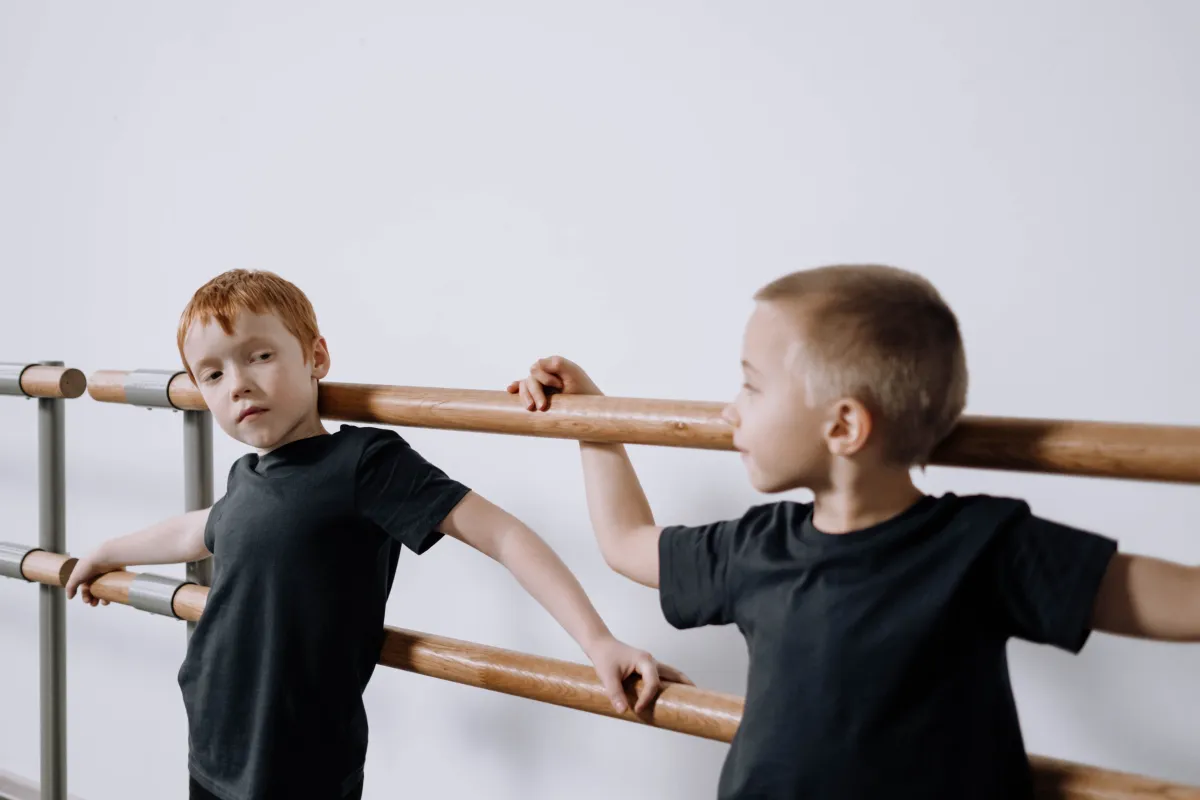
Growth spurts. This is the reason most parents have never heard, and it has nothing to do with confidence. Boys hit their growth spurt later than girls, usually somewhere between 11 and 14, and it can run for two years. While it lasts, bone outpaces muscle. Strength and flexibility drop away, balance wanders, and steps he had last term stop working. Dance medicine has documented all of it, along with what a teacher should change while it passes.
The timing is the whole point. He goes through that a year or two after the girls beside him, which means he goes through it on his own. Ashe-Browne built INYB's Boys Associates around exactly this, giving them "the time in a safe space to get their strength and coordination back after those big growth spurts".
There is more on what to expect in is ballet good for children.
Staying in dance at all. The schools running these classes are candid that they exist to stop boys drifting away, usually around the age where self-consciousness peaks. A class where every dancer is a boy removes the thing they are self-conscious about.
Where to find boys' classes in Ireland
These are the schools we know are running something for boys. It is a short list, most of it around Dublin and the north east, so a lot of the country is not on it. If that includes you, the next section is the one to read, because a mixed class is the normal route anyway.
- Irish National Youth Ballet, Dublin. The Boys Associate Programme runs every Saturday for ages nine and up. It has run since 2016, and dancers often progress into the main company after a few years.
- Ballet Boost Ireland, Dublin. Runs a Boys Ballet Hub as a named strand of its programme.
- Ruth Shine School of Dance, Wicklow. Timetables a Boys Ballet class for ages eight to twelve, alongside boys-only dance classes.
- Newry Dance Theatre Arts, Down. Lists boys-only among its recreational class types.
- Active Dansa, Antrim. Runs a class called Boys, Dance and Technique, designed for male dancers.
- Verve Dance Studio, Antrim. Runs regular boys' dance days rather than weekly classes, and describes itself as championing boys' dance.
- AOK-DANCE, Tipperary. Runs a boys' contemporary class in Clonmel, alongside its graded ballet.
- The Loft Dance Studio, Dublin. Aims to run a boys' class every two weeks in Dun Laoghaire, subject to bookings, restarting in September 2026 after a summer break. The studio's listed classes start at age 14, so ask before assuming it suits a younger boy. Male students also take weekly private lessons with the school's male ballet teacher, Fernando Palma.
- The Goode School of Dance, Dublin. Runs a boys-only class, though in hip hop rather than ballet.
Schools change what they offer from term to term, and plenty run classes they never put online. If you run a boys' class and you are not on this list, tell us and we will add it.
If there is no boys' class near you
Most of the country has no boys-only option, which will be the situation for most people reading this. Three questions are worth asking on the first phone call.
Ask the school how many boys are in the class. Some mixed classes already have two or three, which changes the experience entirely. Schools generally know the number and will tell you.
Ask whether boys are taught different work. In ballet they should be. Boys and girls diverge in the syllabus as they progress, with boys doing different jumps, different turns and, later, quite different strength work. A good mixed class already accounts for this.
Ask about male teachers and older male students. A boy who never sees a man dance has a narrower picture of what he is doing than one who does.
Ask anyway, even if the answer is no
These classes only exist where enough boys turn up to fill them, and in most towns that has not happened yet. No school can justify a room, an hour and a teacher for two boys, however much it might like to.
That is a reason to ask rather than assume. A school that hears the question more than once has something to work with. A school that never hears it has no reason to think about it at all. If you would send your son to a boys' class, say so, even where the answer this term is no.
The Billy Elliot effect, and what actually happened
Billy Elliot, released in 2000, is routinely credited with getting a generation of boys into ballet. The picture is more interesting than the received wisdom.
It was contested from inside the profession. Royal Ballet dancers have argued publicly that the effect was a myth where it mattered most, that the film did not persuade working-class families to send their sons to dance, and that it largely reached households already inclined towards ballet.
What is not in doubt is where things stand now. In 2025, in his first interview after becoming Artistic Director of the Royal Ballet School, Iain Mackay put the current position plainly: eight times more girls than boys apply. Whatever the film unlocked, it did not hold on its own.
Which is the honest case for programmes like INYB's. A film creates a moment. Only steady provision turns a moment into dancers.
The Arts Council says much the same about Irish dance generally: some of the highest participation figures of any art form, and some of the lowest for production. Plenty of people dancing, not much built to catch them, and dancers who historically had to leave the country to train.
Ballet and sport
A boy who takes up ballet gets asked why. A boy who takes up ballet to improve his kicking gets told fair play. Same class, same hour, same aching calves on Sunday morning. Only the reason he gives at the school gate changes.
The sporting case is real and hardly anyone has heard it, which makes it useful for talking a reluctant nine year old round. Rio Ferdinand won a ballet scholarship before he chose football. Wigan Warriors put their under-19s through weekly ballet and saw fewer ankle and knee injuries. Elite dancers tear their ACLs far less often than team-sport athletes, which researchers put down to the years they spend learning how to land.
What carries over is single-leg strength, landing well, and knowing where your body is without looking at it. GAA, rugby, soccer, athletics. Nobody has ever had to defend the word conditioning in a dressing room.
And if none of that shifts him, there is a simpler version. Plenty of children never find a sport that suits them, and a weekly class where nobody sits on a bench and nobody gets picked last is a good way to be active. Moving at all beats waiting for the perfect activity.
What boys wear to ballet class
Short version: fitted shorts or leggings, a fitted t-shirt, and black ballet shoes. Nothing baggy, because the teacher needs to see alignment. No leotard, and no pointe shoes. Our full guide to what to wear to ballet covers kit for boys and men, including shoes and what to expect as students get older.
Finding a school
Browse every ballet school in Ireland, or start with your county. If you are weighing up options, choosing a ballet school covers what to ask on a first phone call, and what is ballet explains how the training is structured.
Sources. Injury and landing research: Liederbach et al. 2008 and 2014, American Journal of Sports Medicine. Royal Ballet School applications: Iain Mackay interview, Gramilano, 2025. On the Billy Elliot effect: Dance Directory. Rugby and ballet: AF Performing Arts and The Irish Times. Growth spurts: The Challenge of the Adolescent Dancer, IADMS. Irish participation figures: Advancing Dance 2022-2025, Arts Council of Ireland. Programme details and quotations from Lindsay Ashe-Browne, Artistic Director, Irish National Youth Ballet, by correspondence.
Frequently asked questions
Is ballet for boys?
Yes. Boys train in the same schools and sit the same exams as girls, and around 20% of dancers in Irish National Youth Ballet, the national youth company, are male. Most boys in Ireland train in mixed classes. A small number of schools also run boys-only classes.
What do boys wear to ballet class?
Fitted shorts, leggings or dance tights, a fitted t-shirt tucked in, and black or white ballet shoes. No leotard and no pointe shoes. Our guide to what to wear to ballet covers it in full.
At what age can a boy start ballet?
The same age as anyone else. Most Irish schools take children from around three, and boys can start much later and still progress. Irish National Youth Ballet's Boys Associate Programme takes dancers from age nine with at least a year of training behind them.
Are there boys-only ballet classes in Ireland?
A handful, clustered in Dublin, Wicklow and Northern Ireland. Most of the country has no boys-only option, so mixed classes are the normal route and boys do perfectly well in them. Provision follows demand, so it is worth asking your own school even if the answer this term is no.
Do boys and girls learn the same things in ballet?
At the start, yes. As students progress the syllabus diverges, with boys doing different jumps, different turns and different strength work, and girls going on to pointe. A good mixed class already teaches boys their own material.
Last checked: 28 August 2026