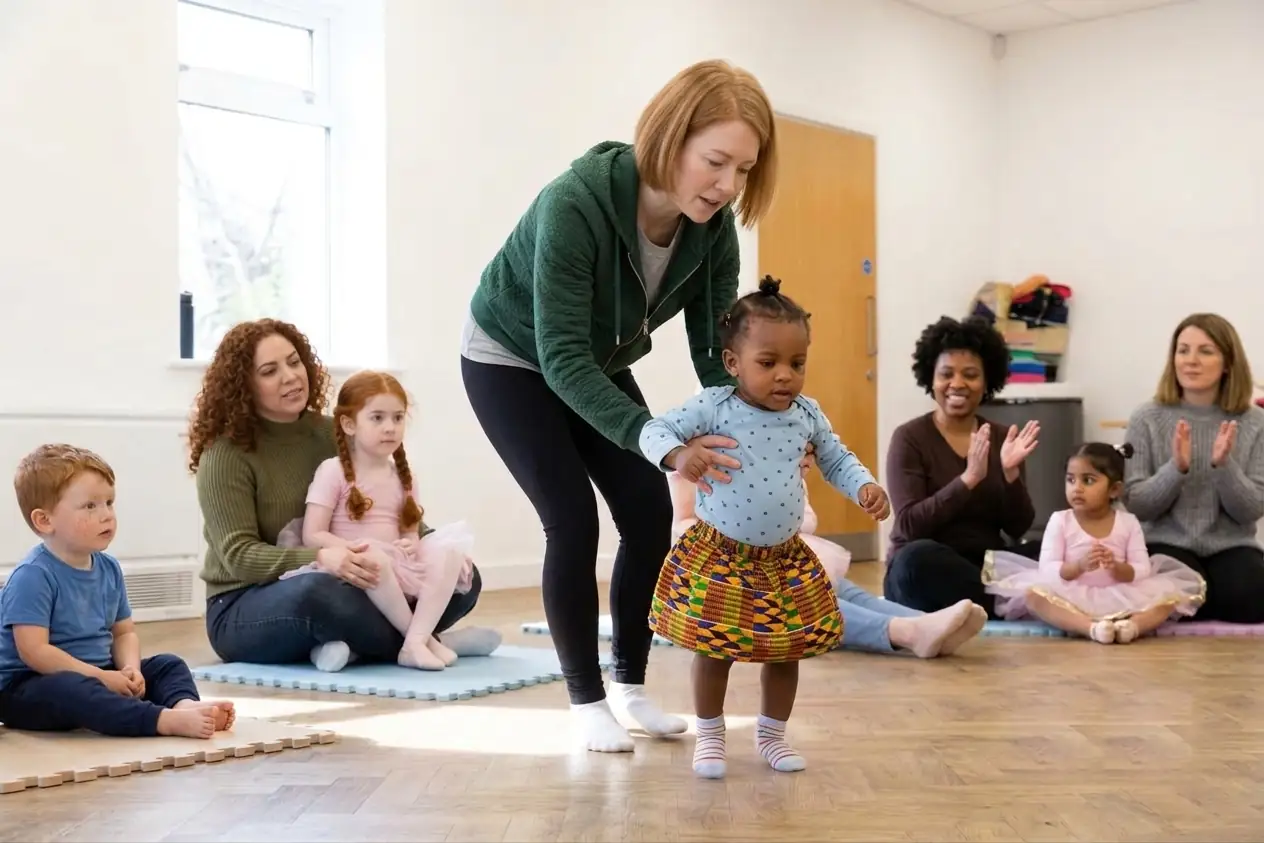
Baby ballet starts far earlier than most parents expect. Irish schools run parent-and-toddler classes from as young as 12 months, toddler classes from around age 2, and pre-ballet from 3. The sessions are short, built on songs, props, and movement games, and at the youngest ages a parent or guardian joins in. Below is every school we have verified as currently offering baby or toddler classes, county by county.
What happens in a baby ballet class
Nothing formal, and that is the point. A typical session runs 30 to 45 minutes and moves quickly between action songs, dancing games, props like ribbons and teddies, and simple movement: marching, tiptoes, jumps, and the first playful stretches. The aims at this age are rhythm, coordination, confidence, and associating the studio with fun. For classes under age 3, the grown-up usually takes part rather than watching from the side.
From around age 3, children move into pre-ballet or creative movement classes on their own, where skipping, galloping, balance games, and a first look at ballet positions lay real groundwork. Our guide to starting ballet in September covers that next step, term dates, and costs.
How baby ballet helps development
The skills a toddler practises in a dance class map closely onto early childhood development. Marching, jumping, tiptoeing, and twirling build gross motor skills: the big-muscle control behind balance and coordinated movement. Handling ribbons, scarves, and teddies, and later putting on ballet shoes, works the small muscles of hands and feet that fine motor control depends on. Moving to music develops rhythm and listening, and the songs that carry every class feed language along the way.
The class format itself teaches as much as the movement. Waiting for a turn, following a simple instruction, copying a teacher, and dancing alongside other children are early social skills, practised somewhere designed to be joyful. At the parent-and-toddler stage there is a benefit for the grown-ups too: a weekly session with other parents of children the same age.
None of this requires talent, and none of it is about producing a dancer. A child who does a year of toddler ballet and never dances again still walks away with better balance, body confidence, and a positive first experience of a class environment.
Schools with baby and toddler classes right now
Each school below currently advertises a baby, toddler, or parent-and-toddler class on its own website (verified July 2026). Timetables change between terms, so confirm the current schedule with the school before travelling. This list grows as schools announce autumn timetables.
Antrim
- Naomi Orr School of Dance (Lisburn): parent and toddler classes from 12 months.
- The Judith Keyes School of Ballet (Newtownabbey): Baby Ballet, from confidently walking to preschool age.
- Verve Dance Studio (Cullybackey): Dance Scamps, ages 2.5 to 3.5.
Cork
- The Joan Denise Moriarty School of Dance (Cork): ballet from age 2.
Down
- Excel Dance Company (Newtownards): Parent and Toddler Ballet, from 12 months to 3 years.
- Newry Dance Theatre Arts (Newry): Teeny Bop parent and toddler class, ages 1 to 3.
- Novaes Ballet School (Moira): Mother and Baby, Parent and Toddler, and Family classes.
Dublin
- Brocklebank Academy of Dance (Dublin): Baby Ballet, ages 2 to 3.
- Clare Connolly Dance & Ballet School (Dublin): Baby Ballet, ages 2 to 3.
- Leinster School of Dance (Dun Laoghaire): Baby Ballet.
Galway
- Galway Dance Centre (Galway): Creative Toddlers, Saturday mornings.
Louth
- Malone Dance Academy (Dundalk): Parent and Toddler class.
Wicklow
- Ruth Shine School of Dance (Blessington): Wobblers and Toddlers, an introduction to music and movement for little ones and their grown-ups.
- Wicklow School of Dance (Wicklow Town): Dance With Me, ages 2 to 3 with a guardian.
No class near you on the list yet? Many schools only publish toddler classes when a new term opens. Browse ballet classes by county and ask the schools closest to you: if enough families ask, classes get added.
Pre-ballet and creative movement, from age 3
Once a child turns 3, they can usually join a class on their own. These go by different names from school to school: pre-ballet, pre-school ballet, creative movement, creative dance, or tots. All cover similar ground, introducing ballet through play, music, and imagination before formal grades begin around age 5 or 6. The schools below currently advertise a class of this kind (verified July 2026).
Antrim
- Verve Dance Studio (Cullybackey): preschool ballet, ages 3.5 to 4.5.
Down
- Nicola Campbell School of Ballet (Downpatrick): Pre-School Ballet, age 3 and up.
- Professional Academy of Dance NI (Holywood): Pre-School Ballet, ages 2.5 to 4, and Mini Dancers, ages 3 to 5.
Dublin
- Clare Connolly Dance & Ballet School (Dublin): Introduction to Ballet, ages 3 to 5.
- East Coast School of Ballet (Malahide): Pre-School Ballet, ages 3 to 4.5.
- Jill O'Neill School of Dance (Dublin): Junior Ballet, ages 3 to 6.
- Marian Lennon School of Ballet (Dublin): Pre-School Ballet, ages 3 to 4.
- Steptacular Performing Arts (Dublin): Stage School Tots, with ballet from age 3.
Galway
- Corrib Dance Academy (Galway): Pre-Ballet, ahead of Pre-Primary and Primary grades.
- Galway Dance Centre (Galway): Creative Dance.
Limerick
- Dance Academy Limerick (Limerick): Rag Dolls creative dance and movement, ages 3 to 4.
What to bring and what it costs
Nothing needs buying. Comfortable clothes your child can move in and bare feet or non-slip socks are all any school expects at this age; ballet shoes can wait years. Sessions are short, so fees sit below regular children's class rates, and many schools offer a cheap or free trial session. Our what to wear guide covers the details for when classes get more formal.
Run a baby ballet class?
If your school offers baby, toddler, or parent-and-toddler classes and is not listed here, tell us and we will add you. Mentioning it on your ballet.ie listing helps parents find you too.
Frequently asked questions
What age can babies start ballet?
Parent-and-toddler ballet classes run from as young as 12 months at some Irish schools, with a grown-up joining in. Toddler classes without a parent typically start around age 2, and pre-ballet from age 3.
What happens in a baby ballet class?
Short sessions of 30 to 45 minutes built on action songs, props, dancing games, and simple movement like marching, tiptoes, and jumps. The aim is rhythm, coordination, and confidence rather than formal technique.
Do parents take part in baby ballet classes?
For children under about 3, usually yes: parent-and-toddler formats have the grown-up dancing too. From around age 3, children attend pre-ballet classes on their own.
What should a toddler wear to ballet?
Comfortable clothes they can move in, with bare feet or non-slip socks. No ballet shoes or uniform are needed at this age.
How long are baby ballet classes?
Usually 30 to 45 minutes. Schools keep sessions short to match toddler attention spans, and many run them on weekend mornings.
Is ballet good for toddler development?
Yes. Marching, jumping, and twirling build gross motor skills and balance, handling props works fine motor control, moving to music develops rhythm and listening, and the class format practises turn-taking and following instructions in a joyful setting.
Last checked: 27 July 2026