Whether you are a parent looking to understand your child’s ballet report card, a student aiming for vocational training, or a teacher choosing the right syllabus for your studio, understanding the different ballet examining bodies is crucial.
In Ireland and the UK, several internationally recognized organizations regulate dance training. While all aim to promote high standards of classical ballet, they differ in their history, teaching methods, and examination styles.
Here is a comprehensive breakdown of the major ballet examination boards to help you understand which path is right for your dancer's journey.
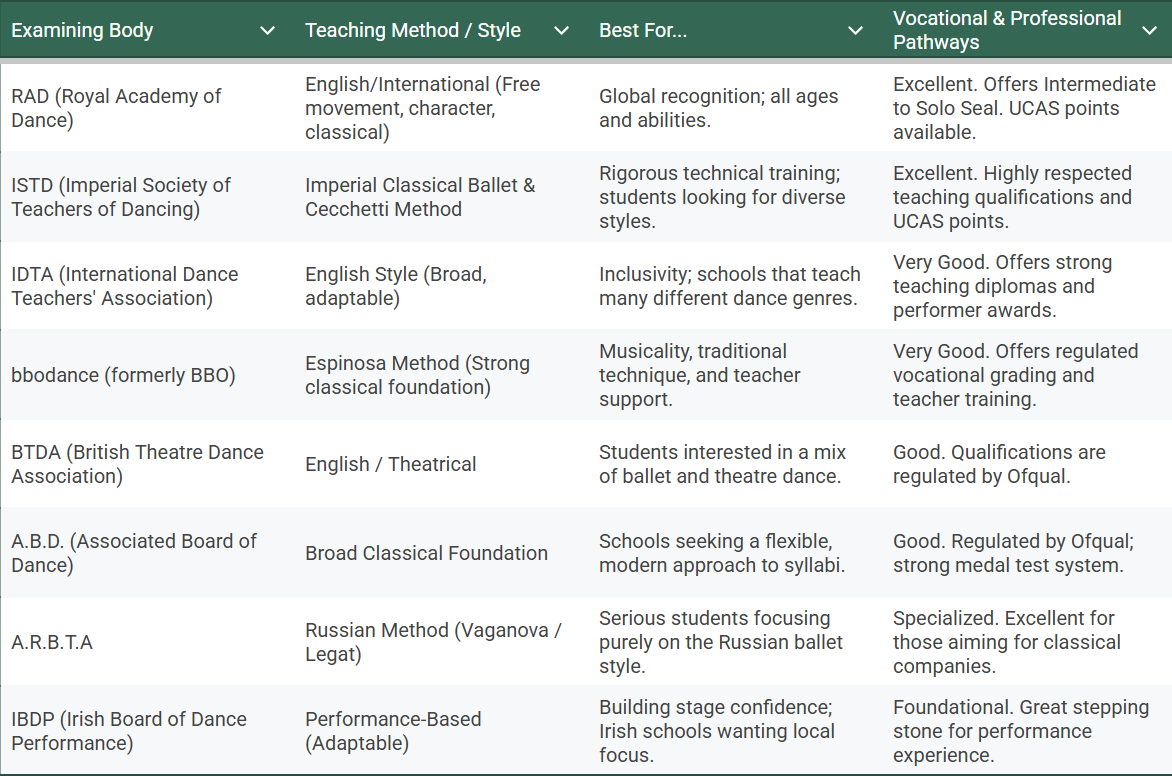
Quick Comparison Table: Ballet Exam Boards at a Glance
This table is designed to give parents, students, and teachers a quick overview of what each board specialises in.
Detailed Breakdown of the Examining Bodies
1. Royal Academy of Dance (RAD)
Founded in 1920, the RAD is one of the largest and most influential dance education organizations in the world.
For Parents: If your child takes RAD exams, their qualifications are recognized globally. The syllabus incorporates classical ballet, free movement, and character dance, making it engaging for children.
For Students: The RAD offers a clear "Vocational Graded" path (Intermediate Foundation up to Advanced 2 and Solo Seal) for those wanting to dance professionally. Higher grades carry UCAS tariff points.
For Teachers: Becoming an RAD Registered Teacher offers immense prestige, access to excellent CPD (Continuing Professional Development), and a vast global network.
2. Imperial Society of Teachers of Dancing (ISTD)
The ISTD is renowned for its technical rigor and covers a massive variety of dance styles. In ballet, they offer two distinct methods: Imperial Classical Ballet (an English style) and the Cecchetti Method (an Italian style known for intricate footwork and pure lines).
For Parents: ISTD exams demand a very high standard of technique. It is a fantastic board for building strong, disciplined dancers.
For Students: Vocational exams are highly respected by professional ballet companies and full-time dance colleges.
For Teachers: The ISTD provides some of the most rigorous teacher training in the industry, ensuring instructors have a deep biomechanical understanding of dance.
3. International Dance Teachers' Association (IDTA)
The IDTA is one of the world's largest dance teaching organizations. It is known for being highly inclusive and adaptable.
For Parents: The IDTA focuses heavily on the joy of dance alongside technique. They offer "Medal Tests" alongside traditional grading, which is great for keeping younger students motivated.
For Students: A great pathway for versatile dancers who want to train in ballet alongside tap, modern, and street dance under the same organization.
For Teachers: Offers flexible syllabi that allow teachers to adapt to the physical capabilities of their students.
4. bbodance (formerly British Ballet Organisation - BBO)
Founded in 1930 by Edouard Espinosa, the British Ballet Organisation rebranded to bbodance in 2016.
For Parents: bbodance focuses strongly on musicality and safe dance practice. It has a beautiful, traditional feel to its syllabus.
For Students: They offer an excellent Scholars Scheme for talented students, providing extra pre-vocational training alongside their regular studio classes.
For Teachers: Known for being an incredibly supportive "family-like" organization with highly respected, regulated teaching qualifications.
5. Associated Board of Dance (A.B.D.)
A.B.D. is an international dance examination board that offers syllabi across multiple genres, including classical ballet.
For Parents & Students: A.B.D. provides a very structured yet modern syllabus. They place a strong emphasis on performance awards, which builds great confidence in young dancers.
For Teachers: They are known for their approachability and for providing teachers with creative freedom within the syllabus framework.
6. British Theatre Dance Association (BTDA)
The BTDA offers regulated qualifications and is heavily focused on theatre arts.
For Parents: Excellent for children who love the stage and theatricality, not just the strict classical elements.
For Students: Offers regulated qualifications (including UCAS points) and provides performance awards that help build a rounded theatrical resume.
For Teachers: Great for schools that run annual productions and want an exam board that complements a performance-heavy studio culture.
7. Association of Russian Ballet Theatre & Arts (A.R.B.T.A)
A niche but highly respected organization, A.R.B.T.A focuses on the Russian methods of classical ballet (primarily Vaganova and Legat).
For Parents: If your school uses this board, your child is learning the same stylistic techniques used by the Bolshoi and Mariinsky ballets—known for athleticism, high extensions, and dramatic flair.
For Students: Essential for vocational students who specifically want to master the Russian technique, which is heavily favored in many European ballet companies.
For Teachers: Requires specialized knowledge of the Russian method to teach effectively.
.
8. Irish Board of Dance Performance (IBDP)
A fantastic domestic organization, the IBDP takes a slightly different approach by focusing heavily on performance rather than strict, syllabus-driven technical exams.
For Parents: A wonderful option for building a child's confidence. Instead of feeling the pressure of a strict classical exam, students are graded on their stage presence, musicality, and joy of movement.
For Students: A great way to gain performance experience and feedback from professional adjudicators in a supportive environment.
For Teachers: Perfect for Irish studios looking for an inclusive, stress-free examination experience that rewards creativity and choreographic freedom.
Which Exam Board is the "Best"?
There is no single "best" exam board. For parents, the most important factor is finding a teacher who is passionate, qualified, and creates a safe environment. For vocational students, boards with Ofqual-regulated higher grades (like RAD, ISTD, bbodance, and IDTA) are generally required for entry into full-time dance conservatoires. For teachers, the choice often comes down to which syllabus best fits their personal training background and the specific culture of their dance school.